Tuesday, January 26, 2010
Sunday Sermon - "Connective Tissue"
Brett's sermon from 1 Corinthians 12:12-31a can be found on his blog. Check it out at blvdchurch.blogspot.com

Musings on the Daily Lectionary
 In today's gospel reading, Jesus heals a man who has been an invalid for 38 years. Surely this is something to celebrate, but Jesus has healed him on the Sabbath, and some of the religious authorities are fit to be tied. Run ins over the Sabbath are featured in all the gospels, so clearly Jesus has something of a reputation for being a religious rule-breaker.
But while it is easy to smugly laugh at the wooden, rigid adherence to rules by Jesus' opponents, rules are essential for any sort of society. And Jesus never speaks against keeping the Sabbath, on having a day focused on God and rest. Jesus' conflict is not with keeping Sabbath, it is with a faith that worries more about Sabbath than about honoring God, that makes an idol out of Sabbath keeping.
Sabbath keeping was a central part of Jewish identity in Jesus' day. It allowed them to maintain an identity distinct from the Roman, pagan world around them. For the devout, it was central to what it meant to be God's people.
Being over zealous about Sabbath keeping is not much of a problem for American Christians, but we have others things that help us stake out our identity as people of faith. For some, going to church on Sunday is the end all and be all of faith. For others, having a "personal relationship with Jesus" is essential, the thing without which their identity is impossible. For still others, if someone has not been "born again," he is deemed not to be a genuine Christian. The more serious people are about their faith the more likely they are to have some essential element of Christian identity that is non-negotiable. But such elements can easily turn into our own idols.
I think that most American Christians would do well to embrace a few more rules and religious disciplines. Our unwillingness to do so often lets us fashion our own personal religion constructed to fit our preferences and tastes, with little there to shape us into the sort of people God wants us to be. Yet religious disciplines and rules must always serve God. No rule, no spiritual practice, no religious experience can become the things we love and serve, for when it does, it then stands between us and God.
Click here to learn more about the Daily Lectionary.
Monday, January 25, 2010
Musings on the Daily Lectionary
 I've always been struck by how many of the Psalms cry out in pain. These "lament" psalms make up the largest single type. And Jesus' cry from the cross, "My God, my God, why have you forsaken me?" quotes the opening verse of Psalm 22. Today's Psalm 57 also cries out to God, seeking refuge. "I lie down among lions that greedily devour human prey; their teeth are spears and arrows, their tongues sharp swords."
Besides being a source of great comfort to faithful people who struggle and suffer, the existence of so many lament psalms also says something about the nature of faithful life. For one thing, being a person of faith does not insulate you from the pain and suffering of this world. The notion that people who suffer somehow deserve it is common, but given how common suffering by good people is in the Psalms, a biblical faith would seem to say otherwise.
Additionally, these psalms point to God's special concern for the suffering. Almost all the lament psalms cling to the hope that God will save those who suffer. And when Jesus quotes Psalm 22 on the cross, he clearly knows that the psalm ends with the promise of deliverance, and the hope that all the faithful will praise God's saving acts.
There is much suffering in the world that is hard to understand. Often there is no good answer to the question, "Why?" But faith clings to the promise that suffering does not mean God has abandoned those in pain. Faith clings to hope that only faith can see, trusting that God will indeed bring forth life from the worst tragedy, even from death.
Click here to learn more about the Daily Lectionary.
Sunday, January 24, 2010
Not preaching but still have something to say
 I'm not preaching today, but I still found myself drawn to the reading from Luke. Jesus is in his hometown of Nazareth shortly after beginning his ministry. He goes to the synagogue on the Sabbath and reads from the scroll of Isaiah where it says, "The Spirit of the Lord is upon me, because he has anointed me to bring good news to the poor. He has sent me to proclaim release to the captives and recovery of sight to the blind, to let the oppressed go free, to proclaim the year of the Lord's favor."
When he has finished reading he says, "Today the scripture has been fulfilled in your hearing." In Luke, this is Jesus' first public teaching. Jesus seems to see himself inaugurating a new day like that promised by the prophet. And most everything about this new day seems to be a blessing for people who are struggling. The poor, captive, blind, and oppressed are singled out, and there is the promise of "the year of God's favor."
This year is surely the Jubilee year found in the Old Testament, where everything and everybody participate in a year long Sabbath. Key components of this Jubilee were the canceling of all debts and the return of all property to its original owners. All of this was about restoring community, helping those who fallen to once again fully participate in the common life of the nation.
Right now, there are some calling for the canceling of debts in Haiti. And while many people are sympathetic to the plight of Haiti, a lot people who have sent contributions to Haitian relief draw the line at things such as canceling debt.
There are some really troublesome attributes to the Kingdom of God. How are we going to teach personal responsibility if we call off debt? How are we going to encourage the sort of risk taking that builds companies and creates jobs if we have a Jubilee every so many years that starts everything over again? Jesus' vision of the Kingdom looks like a threat to much that we take for granted in our world.
And maybe that is precisely the point. The Kingdom is a threat, a threat to all forms of status quo, to all systems that diminish our true humanity. It is a threat to the view that says, "I am totally unimportant and of no worth," instead insisting that all are gifted and called play their part. And it is a threat to the view that says, "Some people don't really matter. They are just workers or statistics or consumers or commodities." Instead the Kingdom features the last entering first.
On a fundamental level, Jesus' notion of the Kingdom calls us to examine what motivates us at our very heart. When we think about whether debt relief for Haiti is a good idea or not, do we decide based on what is best for Haiti and others? Do we make our decisions out of a deep love for those who are suffering, or are we motivated by something else.
I am convinced that people of faith can sincerely come to very different conclusions about the best courses of action in rebuilding Haiti, or ending homelessness in our own community, or dealing with the healthcare crisis. But I suspect that people on all sides have some vested interest in a status quo that is threatened by the Kingdom Jesus brings.
Click here to learn more about the lectionary.
Thursday, January 21, 2010
Musings on the Daily Lectionary
 I've always enjoyed the way John's gospel has Jesus play with words. He will say a word that has one meaning, an obvious, literal one and a figurative one. The person Jesus speaks to will always hear the obvious, literal meaning, and this misunderstanding will provide an avenue for Jesus to speak further. It happens when Nicodemus gets confused about being "born again." There Jesus uses a word that can mean either "born again" or "born from above." English translations have to go with one or the other option, and so we miss the word play.
Today Jesus speaks to a Samaritan woman at a well about "living water." It is possible for us to miss the word play here as well. "Living water" was a colorful way to speak of running water, a flowing stream. Wells, obviously, don't produce living water. And the Samaritan woman's confusion over where Jesus is going to get this refreshing water is understandable. But it is because of this confusion that she raises the question of whether Jesus is greater than Jacob. And her confusion also provides the opportunity for Jesus to speak of the living water he gives that quenches a much deeper thirst.
In John's gospel, understanding Jesus literally is a sure fire way to be left in the dark, and Jesus' opponents are never able to comprehend the deeper level on which he speaks. We modern folks tend to be literalists by nature. We think of myths as untrue and aren't all that good at metaphor or imagery. For many of us, truth means fact. But not in John. In John truth is, "I am the bread of life... I am the vine... I am the light of the world... I am the gate." These phrases are familiar to many of us. But obviously they are not literally true.
I wonder what other truths in the Bible I miss because I don't look beyond the literal.
Click here to learn more about the Daily Lectionary.
Wednesday, January 20, 2010
Haiti Update
 A strong aftershock measure 6.1 on the Richter scale hit Haiti this morning, adding to the misery there. If you are still looking for a way to help, Presbyterian Disaster Assistance (PDA) has already be sending in funds to mission partners on the ground in Haiti. Learn more about PDA's response and donate online at http://www.pcusa.org/pda/
Musings on the Daily Lectionary
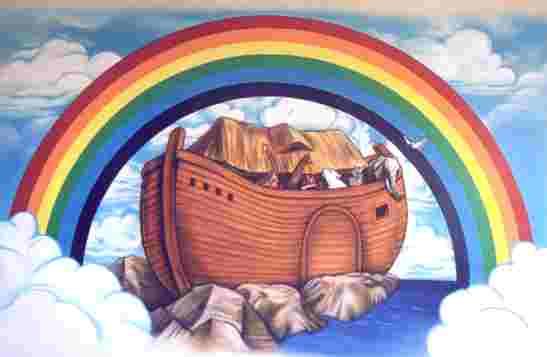 Exploring in my grandmother's attic, I once came across some school work done by my father in the late 1940s. The lesson was from a Bible class (they used to have those in public school), and it covered the Noah story in Genesis. I was startled when I saw what the lesson taught, even though I was born in the still segregated South. The lesson explained that Ham, one of Noah's three sons, was the forerunner of dark skinned people who were forever to be subservient to whites because of the curse found in today's lectionary story.
Considering that there is no mention of race or color, it seems quite a stretch to use this story to justify the treatment of African Americans. And I suppose that should stand as a stark warning about how easy it is for those in power to use the Bible to justify the status quo.
It seems to me that the Noah stories come in for a lot of misuse and misunderstanding. Because of the ark and the animals, people think of them as children's stories. But in truth the Noah stories wrestle with a huge theological question. How will God deal with a Creation that has gone horribly awry. While on the surface the answer might seem to be, "Clean house and start over again," that is not the case. The story is quite clear that this does not happen. The "inclination of the human heart" is not improved at all by the flood, and today's story shows a drunk Noah and a dysfunctional family where relatives end up slaves to relatives. It isn't exactly clear what Ham does that is so bad in the story. (There is some heavy duty sexual innuendo here.) But if Noah and his family were the new start that was supposed to put humanity back on the right track, things have gone to pot almost instantly.
Clearly things are no better off after Noah's flood than they were before. The only thing that really happens in these stories happens with God. God makes a covenant with Creation and humanity. Despite humanity's horrible failings God will not abandon us. The only thing fixed by the Noah event is the elimination of the destroy-and-start-over option. God commits to us, with all our brokenness and sinfulness. Sometimes, when I look at all the horrors that we humans can do -- even the terrible tragedy in Haiti was largely the result of government turning a blind eye to shoddy construction -- it seems like we humans are a hopeless case. But even when we give up on ourselves, God has decided to stick with us. And I guess that is pretty good news.
Click here to learn more about the Daily Lectionary.
Tuesday, January 19, 2010
Musings on the Daily Lectionary
 I used Psalm 146 for the devotion in our staff meeting this morning. We did a form of lectio divina, listening for something in the text to speak to us or grab us, and then seeking to understand why. I and one other person found ourselves drawn to the phrase, "plans perish," which was rather striking when you consider that we were in a staff meeting to make plans.
The psalm speaks of not putting our trust in human rulers whose plans disappear the moment they die. Only God is permanent, eternal. But don't we still have to make plans?
Two thoughts came to me regarding this. The first is how we should strive to connect with God's plans. Too often in churches, plans reflect the personalities and preferences of those doing the planning more than they do what God would want. How do we let God direct our plans?
The second is to accept the fragile and temporary nature of our plans. Because we associate what we do at church with God, we sometimes act as though our worship style, our structures, or our ministries are permanent and eternal expressions of how things should be. And how we've always done it becomes an idol that we serve.
God, what plans are you calling us to make? And what old plans should we let die?
Click here to learn more about the Daily Lectionary.
Sunday, January 17, 2010
Sunday Sermon - "Gifted"
 Some school children get labeled "gifted." While all are gifted in some way, we value some gifts more than others. We label as gifted those with certain gifts. Sometimes we even think that those with the "better" gifts are better individuals. The Apostle Paul thinks otherwise.
Thursday, January 14, 2010
Musings on the Daily Lectionary
 This is only vaguely about today's lectionary verses. None of them seemed all that well suited to what many are thinking about this day, the terrible suffering in Haiti. The gospel reading does speak of those first folks who responded when Jesus said, "Follow me." And I imagine that a lot of Christians, and non Christians, are wondering just what following Jesus means right now.
Pat Robertson apparently thinks it means pronouncing blame. He flatly stated that the devastating earthquake occurred because the Haitians made a deal with the devil centuries ago in order to throw off their French masters. Thus they are under a curse. How the apparently demented Robertson knows about this "deal," I have no idea. But his callous lunacy emerges from a question that many are asking. Where is God in this?
Sometimes people of faith seem extremely worried about protecting God's reputation, and the two easiest outs available are (1) blame the victim or (2) insulate God. Robertson finds it amazingly easy to do the former. Others take the tack of moving God far enough offstage so as not to incur any divine culpability. It was only natural forces at work. And yet such forces are presumably from the creative hand of God, and surely God could have intervened if God wanted to do so. And so at the very least, God has chosen not to help.
For me, a more faithful response is to stop making excuses for God and acknowledge that we often do not and cannot know the mind of God. Sometimes the only answer available to us is the one given to Job. "Where were you when I laid the foundation of the earth..." And sometimes the best we can do when we encounter terrible suffering is to stop trying to determine cause and start trying to help. Jesus says this in so many words when he is asked about whose sin caused a man to be born blind. Jesus says no sin caused the tragedy, but that it exists as an opportunity to reveal God's works.
Perhaps that is the best Christians can do in the face of the suffering we see on our televisions today. Let followers of Jesus simply do what he did when he encountered pain and suffering. He reached out to heal and to make whole. There isn't a soul reading this who cannot do so in some small way.
Click here to learn more about the Daily Lectionary.
Wednesday, January 13, 2010
Musings on the Daily Lectionary
 If you were asked to come up with an image to represent power and strength, what would it be? I guessing that it would likely not be a lamb. Popular images of strength and power when I was growing up included John Wayne, Superman, and any number of cowboy and military heroes. Not a lamb among them.
John's gospel presents Jesus very differently than in the other gospels. Jesus is always in control. Jesus never prays to be spared from the cross in John. Instead, the cross is portrayed as his exaltation. And John narrates Jesus' trial before Pilate in such a way that Jesus is much more in control than Pilate. Pilate is driven about by forces beyond his control while Jesus oversees the event.
And yet, one of John's primary images for Jesus is "the Lamb of God," a lamb who is slain along with the other Passover lambs. Strange that the gospel which depicts Jesus as the least human looking and the most god like would choose such an image. Perhaps this should challenge me to reexamine my own notions of power and strength.
Click here to learn more about the Daily Lectionary.
Subscribe to:
Posts (Atom)